French vs English Discover feed: why US advice doesn't work everywhere
US playbooks promise the moon on Discover. But from one market to the next, the rules shift. Here's why — and what to do instead.
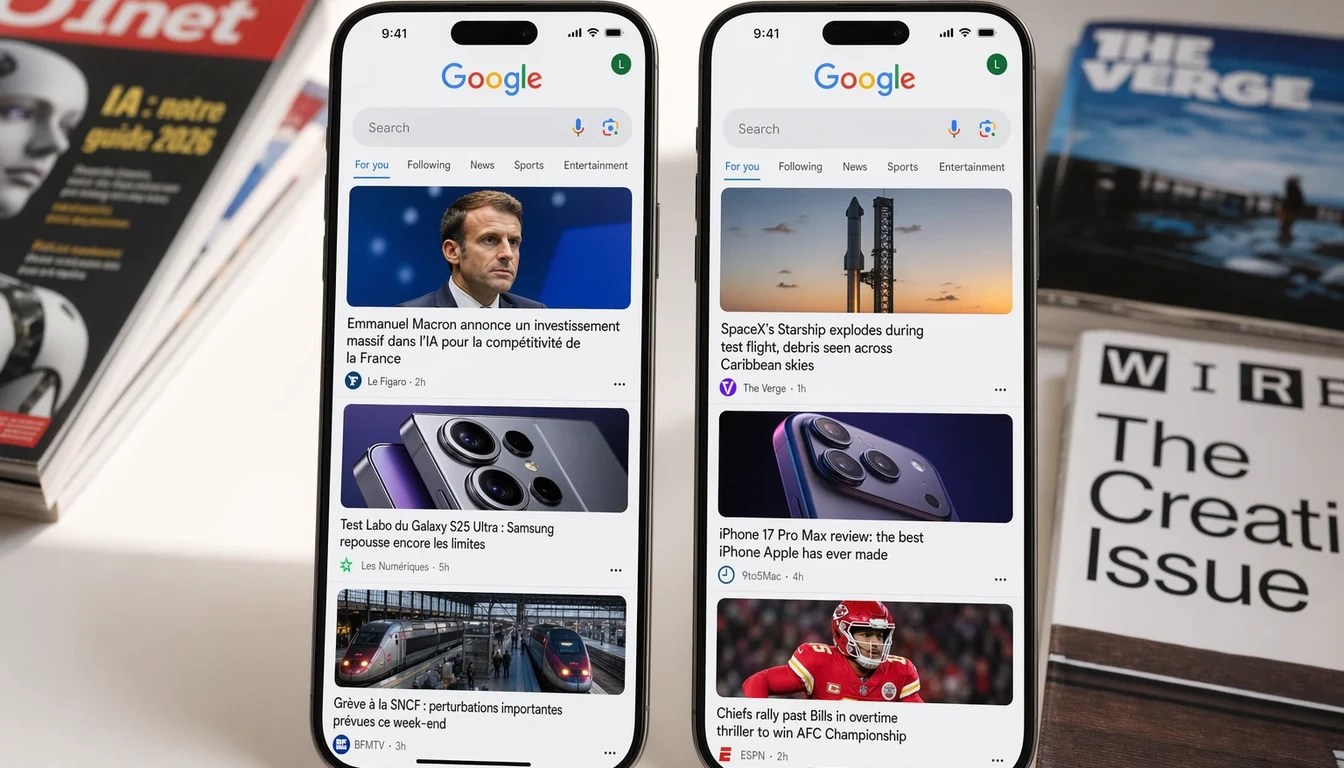
You've probably devoured the US playbooks: "publish 4 articles a day," "keep titles under 65 characters," "use glossy lifestyle imagery"… Apply them verbatim outside the US and the results often disappoint. Why? Because the French Discover feed is simply not the same product as the English-speaking one. Different size, different categories, different unspoken rules.
The French Discover feed is 3 to 5× smaller than the English-speaking one, dominated by legacy print publishers, and leans heavily into specific categories (hard news, celebrities, sports). What crushes it in the US (deep-dive tech, productivity content) often struggles to break through in France. The key: adapt tone, length, and publishing cadence to the market.
Unless explicitly attributed to an external source, the specific percentages, thresholds and time windows mentioned in this article are DiscoReady's or the SEO community's own observations. For officially attested data on Discover's 2026 architecture, see our sourced analyses: Content, Moonstone, Aura — Layer 1 (55% of FR volume) and DeepTrends and DeepTrendsFable — the trends layer. The list of primary sources appears at the end of the article.
3 major structural differences
Before talking strategy, you need to understand what a French user sees vs an American user when they open the Google app in the morning.
Difference 1 — Market size
The French-speaking market (France, Belgium, French-speaking Switzerland, Quebec) totals around 85 million active Discover users. The English-speaking market (US + UK + CA + AU + IN) exceeds 450 million. Mechanically, that changes everything:
- Fewer slots available in FR → competition is concentrated among a handful of major publishers
- Fewer engagement signals per article → the algorithm "knows less" and takes fewer risks
- A US traffic spike on a successful article is worth 5-10× an equivalent spike in France
Difference 2 — Legacy publishers dominate France
In France, 8 of the top 10 Discover beneficiaries are publishers rooted in print (Le Figaro, Le Parisien, Ouest-France, 20 Minutes, BFM, Le Monde, L'Équipe, France Info). This print-inherited dominance crushes independent sites: authority signals have been locked in for decades.
In the US, the landscape is far more fragmented: BuzzFeed, Yahoo, NYT, and CNN coexist with a swarm of digital pure players (Vox, The Verge, Business Insider) and individual creators (popular Substacks). New entrants have far more room to grow.
Difference 3 — User behavior
Internal studies from French publishers converge: the French user scrolls less deeply into the feed (~9-12 cards vs 15-20 in the US), but clicks more often on "hot news" headlines. Consequence: the top 3-4 cards capture a significant share of total CTR in France (measure on your own feed via Search Console). The French game is even more concentrated on "top of feed."
Categories that crush it in France (and nowhere else)
Internal Google Analytics data from our publisher clients paints a clear picture of categories that outperform in FR vs EN:
- Political news and fait-divers — +40% to +80% outperformance in FR, tied to a strong attachment to hard-news press
- Celebrity and reality TV — massive in FR (Closer, Voici, Public, Télé-Loisirs), far more fragmented in the US
- Soccer — overwhelming dominance in FR (L'Équipe, RMC Sport, 90min); in the US, sports is spread across NBA, NFL, MLB, etc.
- Cooking and recipes — the "visual recipe" format is very powerful in FR (Marmiton, Cuisine Actuelle)
- Automotive — major in FR (Auto Plus, Caradisiac), niche in the US
What works in the US and flops in France
Conversely, some US strategies find little traction in France. The main pitfalls to avoid:
❌ 3,000+ word longforms
In the US, long-form content (Atlantic-style, NYT Magazine) finds a loyal Discover audience. In France, beyond ~1,500 words on a non-breaking-news topic, CTR collapses: the user scrolls and moves on.
❌ Long "number + benefit + emoji" headlines
Titles like "7 Productivity Hacks That Saved My Startup 🚀" crush it in EN. In FR, over-marketed titles are penalized by both the algorithm and the reader — they trigger a defiance reflex tied to French media culture.
❌ Tech / startup / VC deep-dives
Deep tech analyses (TechCrunch, The Information style) are consumed en masse in the US. In France, they have a niche audience (Maddyness, Frenchweb), never mass. Betting your Discover calendar on them = rapid ceiling.
❌ High-frequency publishing
In the US, a tier-1 outlet publishing 15-20 times a day is standard. In France, beyond 8-10 articles/day on a mid-size site, you dilute engagement signals: each article gets less attention and the algorithm penalizes the average.
"We copied Vox's playbook for 6 months: volume, aggressive titles, punchy images. Result: Discover traffic divided by 3. The day we went back to our classic French editorial line, we doubled in 4 weeks." — Editor-in-chief, French publisher
The France-specific playbook
If you publish for a French-speaking audience, here are the 5 rules that consistently show up in winning sites:
- Publish less, better — 5 to 8 articles/day is plenty if quality is there
- Factual, neutral headlines — prefer information clarity over Anglo-Saxon sensationalism
- Real contextual images — news photos, recognizable visuals, no glossy abstract stock
- Lean into French cultural moments — la rentrée, Tour de France, elections, national cultural events
- Ensure an active Google Web Profile — even more crucial in FR where authority signals are scarce (check it here in 1 second)
Does your site have an active Google Web Profile?
No Discover tactic works if Google doesn't recognize you as an entity. 1 second to check, free.
Launch the Profiler →Bottom line
The French Discover feed is not a miniature version of the US one: it's its own market, with its own rules, incumbents (legacy print publishers), and specific levers. Copy-pasting Reddit threads or American X-posts without adaptation is often a self-inflicted wound. The right approach: watch the FR sites that are winning (see our detailed case study) and build a strategy calibrated for the French-speaking audience.
If you're just getting started on Discover, begin with our complete definition of Google Discover — you'll find the technical and strategic foundations you need.
Take action in 1 minute
Three free tools the editorial team uses daily — tested across French and international publishers.
📘 Want to go deeper? Grab the free Discover Essentials ebook (33 pages, 25-min read).
Sources and further reading
- 1492.vision — Sylvain Deauré & Damien Andell: Discover monitoring platform, analysis of 42 million cards (Dec 2025 - Feb 2026), FR-specific figures per pipeline
- Metehan Yesilyurt — metehan.ai: Google App SDK decompilation (87,498 Java classes), 8-stage pipeline, JSON-LD > OG priority
- SearchEngineLand — Inside Google Discover: 20 pipelines, 42 million cards: public relay of the 1492.vision analysis (aggregated figures)
- iPullRank, Mike King — Secrets from the Google Algorithm Leak: analysis of the May 2024 Content Warehouse leak (2,596 modules, 14,014 attributes)
- SparkToro, Rand Fishkin: public disclosure of the leak
- Hobo Web — Content Effort Signal: technical detail on the
contentEffortsignal and theQualityNsrPQDatamodule
Frequently asked questions
Can a French site perform on the English-speaking Discover feed?
Technically yes, but it's rare. Even with translated content, a French-hosted site (.fr or French-dominant) stays largely exposed to the FR feed. To target the EN market, you need a separate .com / .co.uk domain, a local editorial line, and authority signals rebuilt from scratch in English.
Should I translate my articles to reach the US/UK market?
Translation alone isn't enough. Literal translations perform poorly: tone, structure, cultural references and editorial expectations all differ. You need to transcreate (editorial adaptation) and publish the EN versions on a dedicated site with its own authority history.
Do the same authority signals matter across markets?
Yes for technical signals (Core Web Vitals, E-E-A-T, presence of a Google Web Profile). No for editorial ones: a site's authority on Le Monde or French LinkedIn doesn't transfer automatically to English-speaking markets. You have to build local EN reputation from the ground up.
Why do Italian or Spanish Discover feeds look more like French than English?
European markets share three traits: historically dominant legacy publishers, audiences that prioritize local information, and smaller volumes than English-speaking ones. That shared foundation creates Discover behaviors that are more similar across IT/ES/FR than they are between UK/US and their linguistic neighbors.
What Discover traffic volume can a pure-French site realistically expect?
For a mid-sized French publisher (1 to 5 million total visits per month), the Discover share typically lands between 200,000 and 800,000 monthly visits once recognition is established. Tier-1 French publishers reach 15 to 40 million. By comparison, a US equivalent would reach 3 to 8 times those numbers.