The 7 fundamental differences between classic SEO and Discover SEO no one explains
Everyone knows classic SEO. Everyone is starting to understand Discover. But very few master both in practice, because the rules oppose line by line. Here are the 7 operational differences to internalize in 2026.
SEO teams still publishing in 2026 like it's 2019 are burning half their potential traffic without knowing it. Not for lack of effort — for lack of alignment. A single article, written under a single set of rules, has no reason to perform on Google Search and Google Discover simultaneously. The two channels simply don't obey the same laws.
Here are the 7 operational differences that change everything in your editorial plan. Each one is documented with an actionable rule.
Unless explicitly attributed to an external source, the specific percentages, thresholds and time windows mentioned in this article are DiscoReady's or the SEO community's own observations. For officially attested data on Discover's 2026 architecture, see our sourced analyses: Content, Moonstone, Aura — Layer 1 (55% of FR volume) and DeepTrends and DeepTrendsFable — the trends layer. The list of primary sources appears at the end of the article.
1. The objective: a query vs a profile
Classic SEO has a clear mandate: match an explicit query. The user types "best CRM software 2026"; Google finds pages that best answer that intent. It's a two-sided marketplace — a question posed, an answer provided.
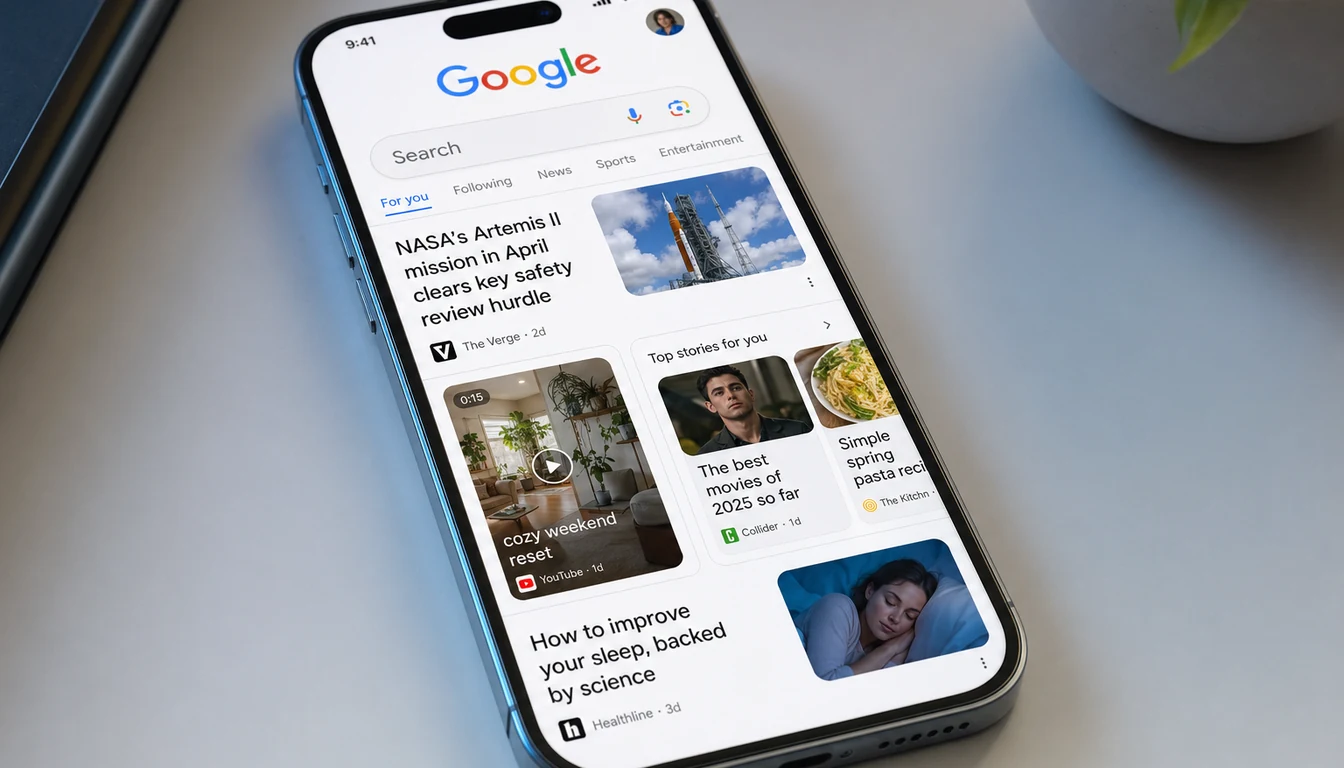
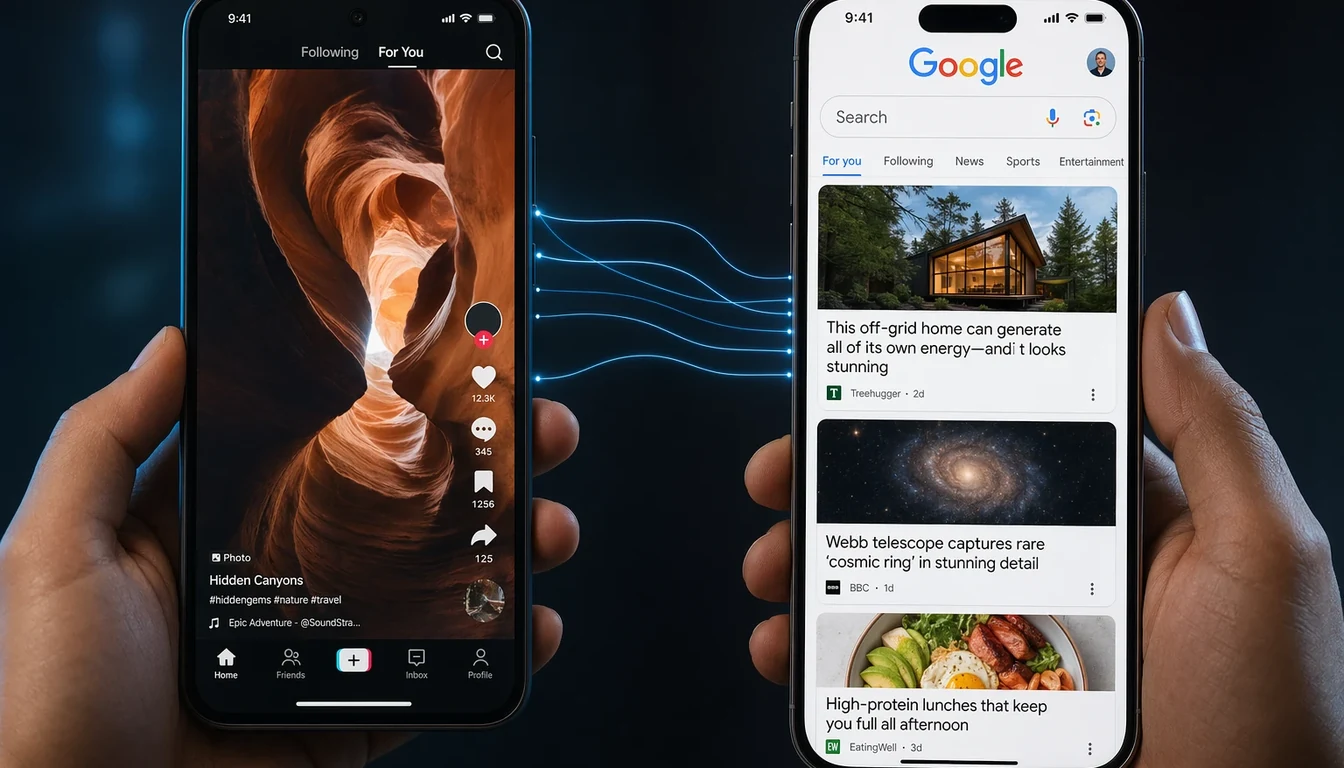
In Discover, there is no query. The user isn't searching for anything; the algorithm decides to push an article based on their behavioral profile (YouTube, Chrome, Maps history, Google app activity). The match happens between a piece of content and a user, not between a page and a keyword.
Consequence: an article that "perfectly answers a question" can fail in Discover. You have to tell a story that triggers a profile's curiosity, not deliver a clinical answer.
2. The title: keywords vs emotion
Classic SEO rule: put the primary keyword in the first 60 characters, ideally at the start. "CRM Guide 2026: Top 10 Solutions Compared" ticks every Search box.
In Discover, that same title is counterproductive. Overly keyword-dense titles signal to the algorithm that the content is SEO-oriented, not reader-oriented — Discover demotes them. The Discover-winning title is narrative, emotional, intriguing: "I tested 12 CRMs in 30 days — here's the one that tripled my conversions."
Simple rule: if your H1 contains 3 or more keywords, you wrote for Search, not for Discover. Our 7 techniques to boost Discover traffic break down the title patterns that actually get through.
3. The hero image: decorative vs editorial
In SEO, the image is incidental. A vaguely on-theme stock photo works — ranking barely depends on visuals.
In Discover, the image is the content. A Discover card is 70% visual and 30% text. Weak image = card ignored. High-performing visuals:
- Minimum 1200×675 (16:9), never less
- No embedded text — Google often rejects them from the feed
- Photo-realistic, original visuals, no obvious stock
- High contrast, subject recognizable with your thumb on a 6" screen
4. Freshness: evergreen-friendly vs 48–72h window
This is the most underestimated difference. In SEO, an article "How to invest in stocks" published in 2022 can still rank in the top 3 in 2026. Evergreen is a valid strategy.
In Discover, the promotion window is brutal: 48 to 72 hours after publication. Past that window, the algorithm has decided whether to push or not — and if it didn't push, it almost never does later. Evergreen articles only break through in Discover if they benefit from a visible update (modified date, rewritten intro, refreshed numbers) or a topical interest spike (news event, related trend).
Rule: publish in waves, capitalize on the news cycle, and drop the idea that content "earns traffic over time" in Discover.
5. Authority: DA/DR vs entity recognition
Domain authority (Domain Rating, Domain Authority) has been the SEO pillar for 15 years. Backlinks, link juice, aggregated E-E-A-T — all translate into a global score that lifts every page.
In Discover, that score weighs less. What counts is entity recognition via the Google Web Profile: does Google identify you as a brand, a credible editorial source on your topic? A DR-40 site with a confirmed entity often outperforms a DR-70 site without a validated entity in Discover.
Your first Discover task: check whether Google has assigned you a profile. Test it in 1 second with our Profiler — if it's empty, no other technique will work.
6. CTAs: aggressive vs restrained
In SEO, dropping an email CTA in the first 300 words is a classic conversion tactic — no meaningful Search penalty.
In Discover, it's the #1 dwell-time killer. An email popup at 5 seconds, a "Subscribe" banner between H1 and H2, a disguised paywall — each one cuts the time spent on page, and dwell time has become the king ranking signal on Discover in 2025–2026.
Operational rule: no CTA in the first third of the article. Place every conversion lever after the conclusion, where the engaged reader can still see them without disrupting the rest.
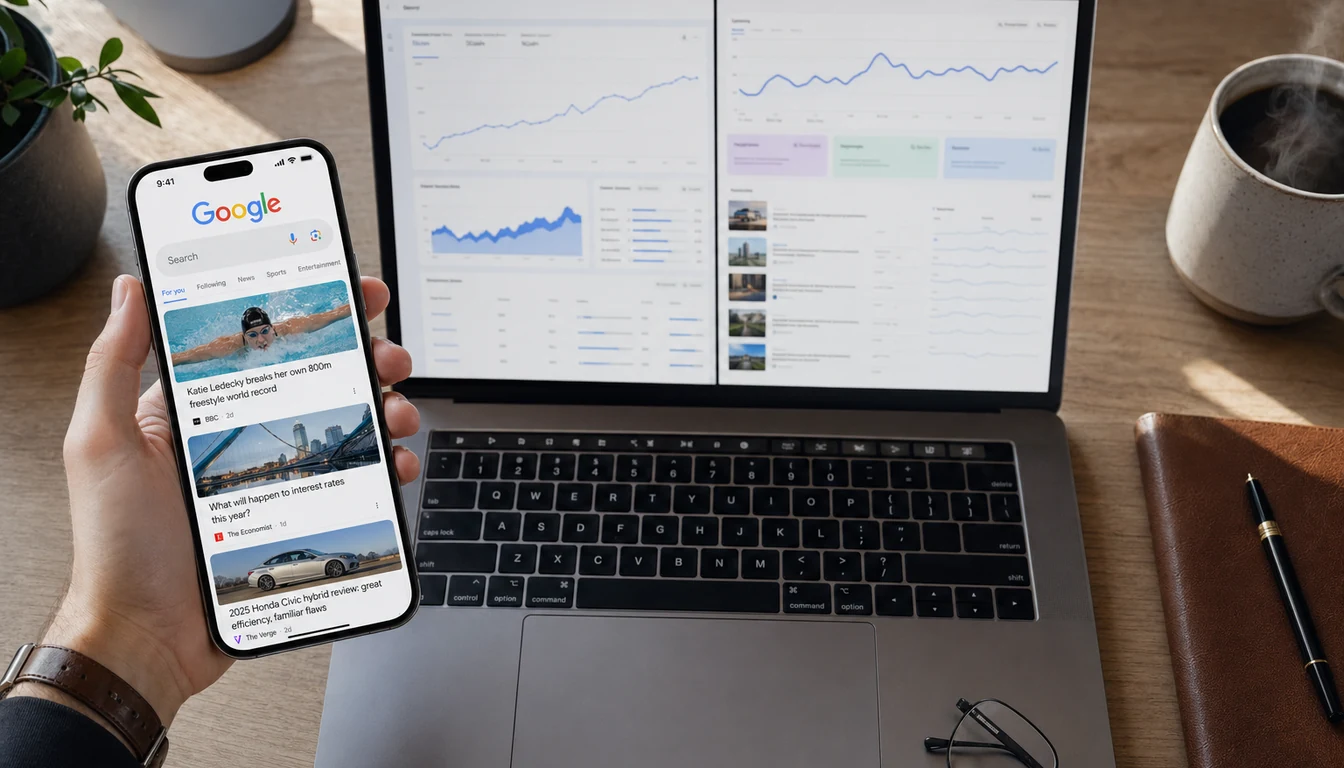
7. Measurement: GSC Performance vs Discover report + GA4 segments
Measuring SEO means opening Google Search Console → Performance → Search. Impressions, clicks, CTR, average position. Everything is clean, documented.
Measuring Discover demands a separate stack:
- Google Search Console > Performance > Discover: the official report (impressions, clicks, CTR)
- GA4 with
googledistributionsegment orgoogleapis.comreferrer: for sessions, pages/session, ad revenue - No exact dwell-time metric — you have to estimate via GA4 "engaged sessions" and average time on page
Our data-driven Discover vs SEO analysis breaks down the full setup across 47 publishers.
The 7 differences in one paragraph: Search targets a query, Discover targets a profile. Search loves keywords in the title, Discover flees them. Search ignores the image, Discover makes it lever #1. Search forgives evergreen, Discover demands freshness. Search values domain authority, Discover values entity recognition. Search tolerates aggressive CTAs, Discover penalizes them. Search lives in GSC, Discover requires a multi-tool stack.
Bottom line: two channels, two playbooks
The temptation to "do both at once" is strong. In practice, fewer than 15% of published articles perform meaningfully on both Search and Discover. The most effective editorial teams in 2026 have adopted a dual editorial plan: 60% of publications target one first, 40% target the other, and flagship pieces target both with title variants and manual relaunches.
Start by auditing your current production: how many of your past articles already follow the Discover rules? If the answer is "fewer than 20%", you know where to find your next growth lever.
Take action in 1 minute
Three free tools the editorial team uses daily — tested across French and international publishers.
📘 Want to go deeper? Grab the free Discover Essentials ebook (33 pages, 25-min read).
Sources and further reading
- 1492.vision — Sylvain Deauré & Damien Andell: Discover monitoring platform, analysis of 42 million cards (Dec 2025 - Feb 2026), FR-specific figures per pipeline
- Metehan Yesilyurt — metehan.ai: Google App SDK decompilation (87,498 Java classes), 8-stage pipeline, JSON-LD > OG priority
- SearchEngineLand — Inside Google Discover: 20 pipelines, 42 million cards: public relay of the 1492.vision analysis (aggregated figures)
- iPullRank, Mike King — Secrets from the Google Algorithm Leak: analysis of the May 2024 Content Warehouse leak (2,596 modules, 14,014 attributes)
- SparkToro, Rand Fishkin: public disclosure of the leak
- Hobo Web — Content Effort Signal: technical detail on the
contentEffortsignal and theQualityNsrPQDatamodule
Frequently asked questions
What's THE most underestimated difference between SEO and Discover?
Content freshness. In SEO, a 2022 evergreen article can still rank in 2026. In Discover, the freshness threshold is 48 to 72 hours — beyond that, promotion odds collapse. It's the metric nobody documents and the one that costs publishers the most traffic.
Can a classic SEO article land in Discover without changes?
Rarely. The title, hero image and intro hook aren't optimized for Discover signals. Simple rule: if you publish targeting SEO, draft an H1 variant (more emotional) and an alternative lead paragraph (more narrative) you can swap in for a Discover re-launch. Or write "Discover-first" from the start.
Does domain authority (DA/DR) matter as much in Discover as in SEO?
Less. Domain authority stays a factor, but Discover mostly measures entity recognition via the Google Web Profile — a far more granular signal than raw authority. A DR-40 site with a confirmed entity often outperforms a DR-70 without a validated entity in Discover.
Should I put aggressive CTAs in a Discover article?
No — counterproductive. CTAs dropped in the first 300 words ("Subscribe", email popups, disguised paywalls) penalize dwell time, which is Discover's king signal. Place CTAs after the conclusion and keep the body as editorial as possible.
How do I measure Discover vs SEO performance separately?
In Google Search Console, two separate reports: "Performance > Search" and "Performance > Discover". Cross-reference with GA4 by creating two segments: a filter google+organic+no googledistribution for Search, and a filter googledistribution or referrer googleapis.com for Discover. The data-driven Discover vs SEO analysis breaks down the setup.
Does your site have an active Google Web Profile?
No Discover tactic works if Google doesn't recognize you as an entity. 1 second to check, free.
Launch the Profiler →